Companies compensate us to keep our service free. Learn more

Augusta Precious Metals Review: Fees, Minimums, Complaints & What They Don’t Publish
Fees and facts checked against Augusta Precious Metals’ own website on October 23, 2026. Every figure below links to its source page in the fees section. If the company changes its prices, this stamp date is when we last verified ours.
Reader-supported disclosure: Gold Harbor Retirement earns commissions when readers use some of the links on this site. This review contains no affiliate links — the link to Augusta’s official site below is a plain link, not an affiliate link. We currently have no affiliate relationship with Augusta Precious Metals.
Quick verdict
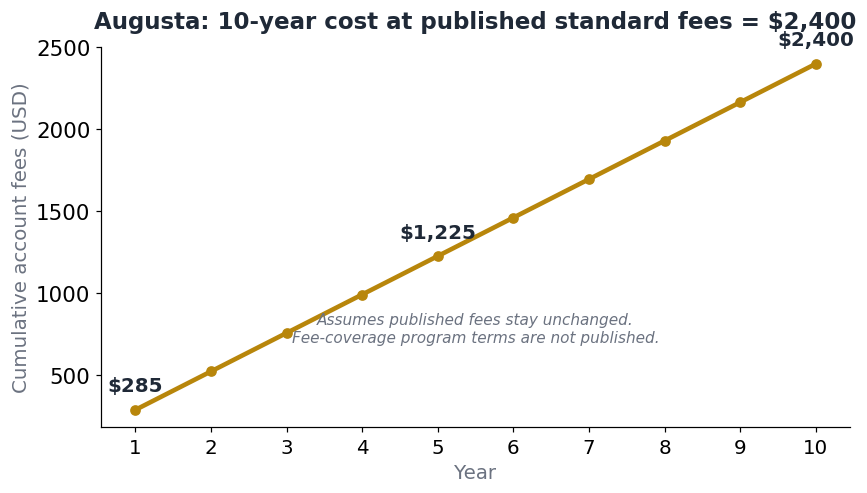
Here’s the short version. Augusta Precious Metals puts its real fees on its own website: $50 to open the account, $125 a year for the custodian, $110 a year for storage and insurance. After year one, that’s $235 a year — and it doesn’t climb as your balance grows.
Here’s the catch. Augusta won’t talk to you unless you have $50,000. That’s the highest minimum in the business, and it ends the conversation for most people before it starts. Got $50k to move? Augusta deserves a look. Don’t? Move on to the next review.
At a glance
| Founded | 2012 |
| Headquarters | Casper, Wyoming (also lists a Beverly Hills, California office) |
| Minimum | $50,000 (IRA or cash purchase) |
| Setup fee | $50 one-time |
| Annual custodian fee | $125/year |
| Annual storage fee | $110/year (storage plus insurance) |
| First-year total | $285 |
| Ongoing annual total | $235/year |
| Metals offered | Gold and silver primarily; ask about other metals |
| Custodian partner | Equity Trust Company (named on Augusta’s site as its “preferred custodian”) |
| Depository | Not published on their own site (third-party sites name Delaware Depository — we could not verify this on Augusta’s pages) |
| Segregated vs. non-segregated | Not published on their own site |
| Wire or transfer fees | Not published |
| Buyback | Terms published (see section below) |
| Fees published on their own site? | YES |

What the company is
Augusta Precious Metals has sold gold and silver for IRAs since 2012. That’s the whole business — no crypto arm, no side hustle.
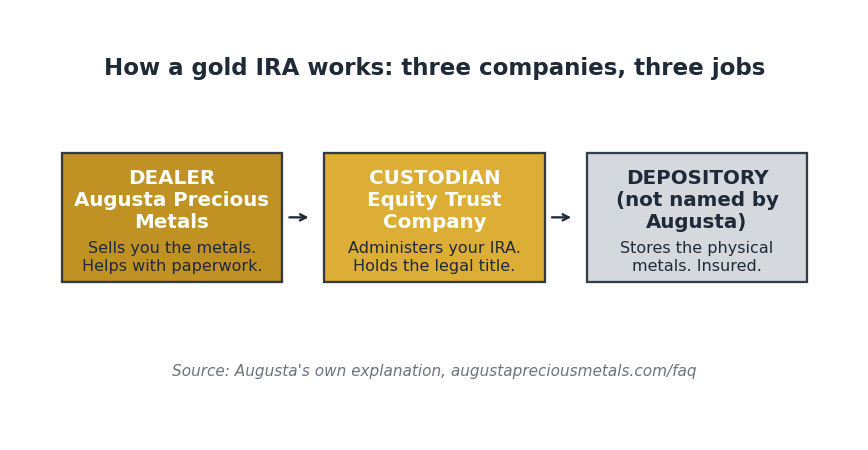
A quick vocabulary lesson, because this industry hides behind titles. The dealer sells you the metal. The custodian is the licensed company that runs your IRA. The depository is the vault where the metal sits. Augusta is only the first of the three — it can’t legally be your custodian, and the metal can’t sit in its office.
Augusta’s pitch is hand-holding. Every buyer gets a one-on-one education session before spending a dime. The people running those sessions earn salaries, not commissions — Augusta says so on its own site. A salaried educator can still steer you. But it’s a different animal from a salesperson who only eats what they kill.
Fees: what they publish, and what they don’t
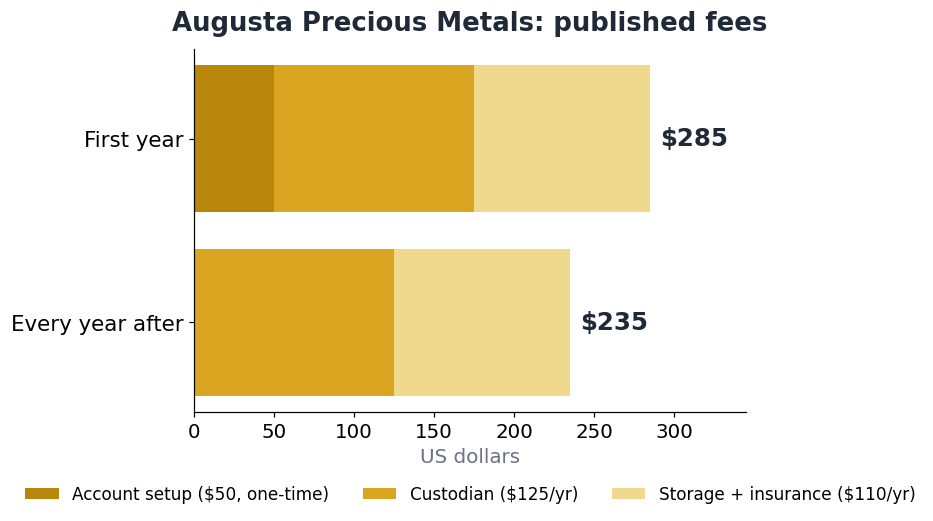
Here’s the schedule, straight from Augusta’s FAQ page. We checked it on October 23, 2026, and the page itself had been updated three days earlier — about as current as it gets:
- Opening the account: $50, once
- Custodian: $125 a year
- Storage and insurance: $110 a year
- Year one total: $285
- Every year after: $235
Source: augustapreciousmetals.com/faq (FAQ: “What does an Augusta precious-metals IRA cost each year?”)
Those are flat fees — a $50,000 account pays the same as a $500,000 one. And they’re third-party charges, not Augusta’s own markup. The metal itself, plus the spread between buying and selling, costs extra.
Now the gaps. Augusta won’t tell you some things:
- The depository’s name. Its FAQ says “approved depository,” full stop. Its site does name Equity Trust Company as its preferred custodian — but the vault itself goes unnamed. Other review sites throw around “Delaware Depository,” but we couldn’t find that name on any Augusta page, so we’re not repeating it as fact.
- Segregated storage. Some companies charge extra to keep your exact bars apart from everyone else’s. Augusta doesn’t say whether it offers this or what it costs.
- Wire or transfer fees. Not listed anywhere we looked.
- The actual rules of its big promotion. Augusta says it “may” cover your custodian and storage fees for up to ten years on qualifying accounts, and that you’ll learn the written terms “before you proceed.” Translation: the terms aren’t published. Until they’re in your hands, in writing, that promotion is worth exactly nothing in your math.
The real cost: premiums and spreads
The flat fees are the small bill. The big one is the spread — what you pay for the metal versus what you could sell it for that same day.
Credit where it’s due: Augusta talks about this more openly than most dealers. Its FAQ says there’s no separate sales commission stacked on the Order Desk’s quote — the quote already includes Augusta’s margin. The educators are salaried. Nobody’s getting a cut per coin.
But you still can’t see prices without calling. There’s no price list on the site. You get the quote — and, to Augusta’s credit, the same-day buyback bid alongside it — on the phone with the Order Desk. That’s better than dealers who hide both numbers. It’s still not the same as shopping around on your own.
One more thing we liked seeing in print: Augusta’s FAQ says flat-out that physical metals pay no interest or dividends and can fall in price. “Neither metal is guaranteed to rise” — on a dealer’s own website. Most of their competitors would never.
Minimums and who gets turned away
Fifty thousand dollars. IRA or cash, doesn’t matter — that’s the price of admission, and Augusta says so plainly. At least the money goes into metal; it’s not a fee on top.
Augusta’s explanation: the minimum supports the white-glove model — personal education, setup help, ongoing support. Fair enough. There’s no published maximum, so the ceiling is whatever their inventory allows.
Here’s why this section is short: that one number settles it for most readers. For reference, from our own October fee research on ten companies: Birch Gold Group says $5,000. Lear Capital says $10,000. Goldco says $25,000. (Source: our October 2026 fee study, [link].)
Products
Gold and silver. That’s the menu. Augusta’s FAQ says you can “ask about” other eligible metals, which is a polite way of saying platinum and palladium aren’t really on offer. Want all four metals in one IRA? You’ll need a different dealer.
Within gold and silver, Augusta sells IRS-approved coins and bars for IRAs, plus premium and collectible coins if you’re buying with cash outside an IRA. Its own advice: stick with standard bullion for IRA accounts, for “maximum cost efficiency and liquidity.” We agree. Premium coins carry fatter markups, and markups are where dealers get paid.
Storage and custodians
Your metal lands in an IRS-approved depository. Augusta’s site names Equity Trust Company as its preferred custodian, but the depository itself goes unnamed on the pages we checked. The $110-a-year storage charge includes insurance — and Augusta’s FAQ is refreshingly blunt that this insurance covers losses, not falling prices. Obvious, but worth printing.
You can’t keep IRA metal at home. Augusta says so directly, and it’s right — take personal possession and the IRS can treat it as a distribution, with taxes and possibly penalties attached.
Augusta says it does about 95% of the rollover paperwork for you. It also says — in writing — that rolling money into the new IRA doesn’t obligate you to buy metal from Augusta. Sit with that for a second. A dealer telling you, on its own site, that you’re free to take its paperwork help and shop elsewhere. You don’t see that every day.
Buyback
Here’s what Augusta publishes about selling your metal back — from its own FAQ, checked October 23, 2026:
- It aims for roughly a 5% gap between what you paid and what it bids back, on qualifying transactions (partial distributions, required minimum distributions). Augusta’s own words: “the target is not a guaranteed future bid.”
- No separate liquidation fee when it accepts a buyback.
- Its “Highest Buyback Price Guarantee”: after you agree to sell on a recorded call, you get 24 hours to find a better bid elsewhere and cancel.
- Regular buybacks are for existing customers.
Sharp-eyed readers may remember an older Augusta claim — “never declined a client buyback.” It was on their site when we first studied it. The FAQ was rewritten on October 20, 2026, and that line is gone, replaced by the process above. The process is more useful than the slogan, but the quiet removal is worth a footnote.
Promotions, decoded
The headline: Augusta may pay your custodian and storage fees for up to ten years on qualifying accounts.
What we verified: the program exists, it covers those two fees, and ten years is the max. What we couldn’t verify: who qualifies, how it pays out, whether you have to ask. Augusta says the written terms come “before you proceed.” Our rule stands: unpublished terms, zero value in your decision until you see them.
One promo Augusta explicitly does not run: free silver. Its FAQ argues — at length — that every free-silver offer it has examined left the buyer worse off once you compare honest purchase and resale prices. Yes, it’s marketing. But the math point checks out: giveaways get funded by markups somewhere.
Reputation and complaints
We checked the BBB ourselves on October 23, 2026. Augusta: A+ rating, accredited since February 2015. One complaint in the last three years — filed in January 2026, about sales and advertising, marked answered. One complaint across more than a decade in business. That’s about as clean as complaint files get.
Trustpilot: 4.8 out of 5, “Excellent,” across 377 reviews, same date. Augusta’s homepage touts “4,000+ 5-star ratings” across Trustpilot, Google, and other sites combined — that’s their marketing number, not ours.
Regulators: nothing. Augusta publishes a page insisting it’s never faced customer lawsuits or state or federal enforcement, and our checks turned up no enforcement record. One third-party blog mentions a 2019 inquiry from Minnesota’s Department of Commerce about product registration — an inquiry, not a lawsuit — which we couldn’t verify from any official source.
Awards: Money magazine’s Best Overall Gold IRA Company (2022–2026) and Investopedia’s Most Transparent (2022–2026), per Augusta’s homepage. Awards are marketing. But “most transparent” happens to match the evidence — Augusta publishes more fee detail than nearly anyone in this industry.
Pros and cons
Every pro and con below traces to a fact verified above.
Pros
- Publishes a complete fee schedule. $50 setup, $125/year custodian, $110/year storage and insurance — printed on its own FAQ page. Almost no competitor does this.
- Flat fees. The $235/year ongoing charge doesn’t rise with account size.
- No separate sales commission. The quoted price includes the dealer margin, and educators are salaried.
- Minimum stated plainly. $50,000, in the open, with the explanation that it goes toward metals.
- Buyback terms published. No liquidation fee, a ~5% spread target stated as a target, and a 24-hour price-shopping window.
- Warns against free-silver promos. Prints on its own site that it has never seen one improve a buyer’s economics.
- Strong complaint record. BBB A+, accredited since February 2015, one complaint in three years; Trustpilot 4.8/5 across 377 reviews (both checked October 23, 2026).
Cons
- $50,000 minimum. The highest among the major companies we studied. Most savers can’t start here.
- Gold and silver only. Platinum and palladium aren’t part of the standard offer.
- Fee-coverage terms not published. “Up to 10 years” of covered fees sounds generous; the qualifying rules aren’t printed anywhere.
- No published price list. You learn actual coin and bar prices on the phone, not the website.
- Buyback not guaranteed. The 5% spread is a target, and the price guarantee lasts 24 hours.
- Depository unnamed. Augusta names its preferred custodian but not the vault that holds your metal.
Who it fits / who should look elsewhere
Augusta fits you if: you’ve got $50,000 or more to move; you want every fee in writing before you call; you like a slow, education-first process with salaried staff; and gold and silver are all you want.
Look elsewhere if: you have less than $50,000 (Birch Gold Group’s $5,000 minimum or Lear Capital’s $10,000 minimum may fit — we are reviewing both); you want platinum or palladium in your IRA; or you want to see actual coin prices online before talking to anyone.
How it compares
This is the first review in our company series. For now, here’s how Augusta stacks up against the field from our own verified fee research:
- Augusta vs. Goldco: Both publish fees, but Augusta publishes one consistent schedule while Goldco’s own pages give three different annual totals (~$180, ~$200, ~$225). Goldco’s minimum is $25,000 — half of Augusta’s. (Full Goldco review coming; fee data in our 10-company fee comparison.)
- Augusta vs. Birch Gold Group: Birch publishes a full flat schedule too — $50 setup, $125/year management, $110/year storage, $235/year ongoing, nearly identical to Augusta’s. Birch’s stated minimum is $5,000. If the minimum is your barrier, Birch is the comparison to make. (Full Birch review coming.)
- Augusta vs. American Hartford Gold: American Hartford Gold publishes zero fee figures on its own site — no setup, no annual fees, no minimum. Augusta publishes everything. On transparency alone, it is not close.
FAQ
What are Augusta Precious Metals’ fees?
$285 in year one — that’s $50 to open the account, $125 a year to the custodian, and $110 a year for storage and insurance — then $235 a year after that. These are third-party account charges; the metal and the buy-sell spread cost extra on top. We pulled these numbers from Augusta’s own FAQ page on October 23, 2026: augustapreciousmetals.com/faq.
What is Augusta’s minimum investment?
$50,000 for your first purchase, IRA or cash. It all goes into metal — it’s not a fee. Same source as above.
Does Augusta buy back the metals it sells?
Yes, and the process is published: a private valuation, live pricing from its Buyback Desk, a recorded confirmation call, no separate liquidation fee. It aims for roughly a 5% purchase-to-buyback spread on qualifying transactions, but — its own words — it doesn’t guarantee that number. (Source: their FAQ.)
Does Augusta offer free silver or fee waivers?
No free silver. Augusta’s site actively warns against those promos. It does have a program that may cover your custodian and storage fees for up to ten years on qualifying accounts — but the qualifying terms aren’t published, so we couldn’t verify them. (Source: their FAQ.)
Where are my metals stored, and who is the custodian?
Augusta names Equity Trust Company as its preferred custodian on its own site. The depository isn’t named. (Sources: augustapreciousmetals.com and its FAQ.)
Is Augusta legitimate?
It’s been operating since 2012, prints its fees, holds a BBB A+ (accredited since February 2015, one complaint in three years), and we found no regulator enforcement record. Still: verify everything in writing before you send money, and consider an advisor who doesn’t sell metals. Our guide to choosing a gold IRA company walks through the questions to ask.
Bottom line
Augusta Precious Metals publishes more about its costs than almost any competitor: exact fees, a plain-English minimum, published buyback terms, and a written warning that its own industry’s free-silver promos don’t add up. That transparency is the reason to consider them.
The $50,000 minimum is the reason most people won’t. And the unpublished details — the fee-coverage qualifying terms, the depository’s name, actual coin prices — show that even the industry’s most transparent company still keeps some cards face down.
If you have $50,000+ and value published fees over salesmanship, Augusta belongs on your short list. Get the fee-coverage terms and the buyback terms in writing before you fund anything. You can start at augustapreciousmetals.com (plain link, not an affiliate link).
Reader-supported disclosure: Gold Harbor Retirement is reader-supported. We may earn commissions from some companies we review. This page contains no affiliate links — the link above is a plain link to Augusta’s official site. We will update this note if that changes.

[…] Augusta Precious Metals publishes a cleaner fee picture but asks $50,000 to start — read our Augusta review for the full comparison. Birch Gold Group and American Hartford Gold both publish less than Goldco […]