Companies compensate us to keep our service free. Learn more

Birch Gold Group Review: Fees, Minimums, Complaints & What They Don’t Publish
Fees and facts checked against Birch Gold Group’s own website on October 30, 2026. Every figure below links to its source page in the fees section. If the company changes its prices, this stamp date is when we last verified ours.
Reader-supported disclosure: Gold Harbor Retirement earns commissions when readers use some of the links on this site. This review contains no affiliate links — the link to Birch Gold Group’s official site below is a plain link, not an affiliate link. We currently have no affiliate relationship with Birch Gold Group.
Quick verdict
Birch Gold Group publishes its fee schedule. All of it. Setup, wire, storage, management, the annual total, and the deal that wipes out your first year if you move $50,000 or more. In this industry, that kind of plain printing is rare enough to matter. Only four of the ten companies in our fee study did it, and Birch was one of them.
That does not make Birch simple to judge. The fees it prints belong to the custodian and the depository, not to Birch itself. The coin prices — the part that decides most of what you actually pay — are not printed anywhere. You get those on the phone, in a written quote, before you commit. And the handful of complaints Birch has drawn are almost all about the same thing: the gap between what a specialty coin costs and what it is worth when you sell it back.
If you have $5,000, want a guided rollover, and will insist on a written quote that shows the premium on every coin before you sign, Birch is a serious option. It is not a perfect option. Nothing in this series is. But the fee schedule is real, the partners are named, and the complaint file is small enough to read in full — I did. If you want to browse prices online and compare dealers from your couch, Birch will frustrate you. That is the trade, stated up front.
At a glance
| Founded | “Since 2011” on Birch’s own site; many third-party profiles say 2003 (see “What the company is”) |
| Headquarters | Des Moines, Iowa — 309 Court Avenue, Suite 809 |
| Minimum | $5,000 (IRA); direct-purchase minimum not published |
| Setup fee | $50 one-time (custodian fee, for the custodian most Birch customers use) |
| Wire transfer fee | $30 (custodian fee) |
| Annual storage fee | $110/year (storage and insurance; no segregated/non-segregated split published) |
| Annual management fee | $125/year (custodian fee) |
| First-year total | $315 ($80 one-time fees + $235 annual fees); $0 if your transfer is over $50,000 — Birch pays the first year’s fees |
| Ongoing annual total | $235/year, flat — not a percentage of your account |
| Metals offered | Gold, silver, platinum, and palladium — coins, bars, and rounds |
| Custodian partners | Equity Trust Company and GoldStar Trust Company |
| Depositories | Delaware Depository, Brink’s Global Services, International Depository Services, Texas Precious Metals Depository |
| Buyback | Wording published; terms not published (see section below) |
| Fees published on their own site? | YES |

What the company is
Birch Gold Group is a precious-metals dealer based in Des Moines, Iowa. It sells gold, silver, platinum, and palladium two ways: for delivery to your home, and inside a self-directed IRA. The IRA side is the main business. You request a free information kit, a Precious Metals IRA Specialist calls, and that person walks you through the rollover, the metal choices, the custodian, and the depository.
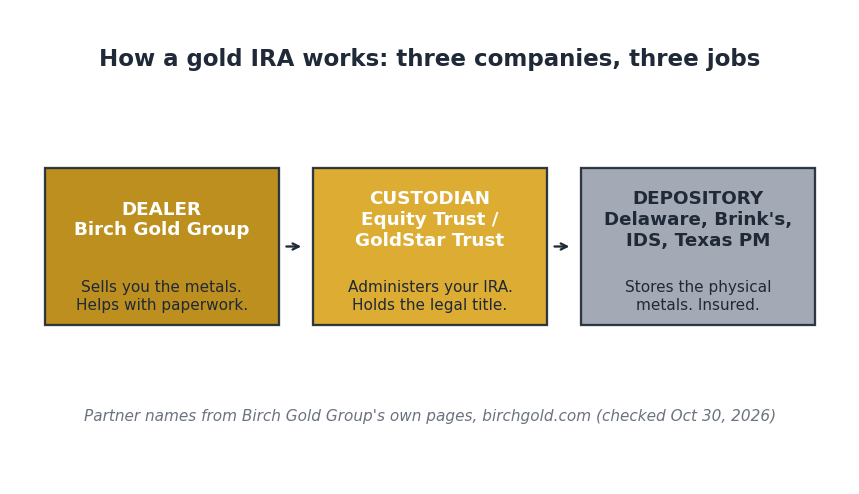
Three jobs, three companies. Birch is the dealer. It sells you the metal and helps with the paperwork. A separate custodian runs the IRA. A separate depository stores the metal in a vault. Birch is not your custodian, and your metal does not sit in Birch’s office. Birch’s own pages explain this split well, and name the partners, which more companies in this series should do.
One wrinkle, and we are not going to smooth it over. Birch’s own website says “since 2011” and “trusted by 40,000+ Americans since 2011.” A lot of third-party profiles say the company was founded in 2003. Both cannot be the founding story. We could not find a 2003 date anywhere on Birch’s own pages we checked. So this review uses Birch’s own date, and flags the disagreement, instead of picking the older date because it sounds more impressive.
Birch markets itself heavily through endorsements. Its homepage names Ron Paul, Dan Bongino, Megyn Kelly, Steve Bannon, and others, and its ads ask listeners to text a keyword to a short code to get the free kit. An endorsement is not a review, and a famous name on a homepage tells you about a company’s marketing budget, not about its coin prices. Judge Birch on the fee schedule and the quote, not on who talks about it on a podcast.
Fees: what they publish, and what they don’t
Here is the schedule, exactly as Birch prints it on its Precious Metals IRA page. I checked it on October 30, 2026, and it matches the figures in our October 19, 2026 fee study, with no changes.
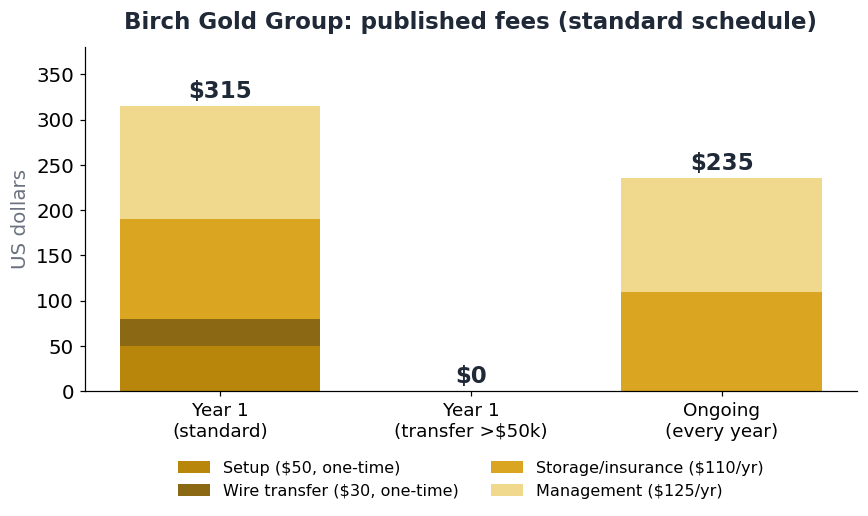
One-time fees: account setup $50; wire transfer $30. Total: $80.
Annual fees: storage and insurance $110; management fees $125. Total: $235 a year.
First year: $315 in total ($80 + $235). After the first year: $235 a year. If your transfer is over $50,000: Birch pays your first year’s fees, so the first year costs $0 in custodian and depository fees, and the $235 a year starts in year two.
Sources: birchgold.com/precious-metals-ira and birchgold.com/prices. Birch’s fee guide, updated October 21, 2026, repeats the same figures: setup “typically around $50,” wire “a typical $30,” storage “around $110,” maintenance “generally around $125.” Source: birchgold.com/blog/retirement/gold-ira-fees.
Three honest caveats, all from Birch’s own pages.
First, these are not Birch’s fees. Birch says so itself on its prices page: “Note that these are not Birch Gold prices or fees.” The $50, $30, $110, and $125 are the fees of the custodian and depository that most Birch customers use. The worked example Birch gives uses Equity Trust as custodian and Delaware Depository for storage. If you pick a different custodian or depository, your figures may differ. Birch’s fee guide says the same: fees “can vary from customer to customer depending on certain factors like the custodian you choose, the size of your gold investment, and your depository.” Treat $235 as the standard case, not as a promise for every combination.
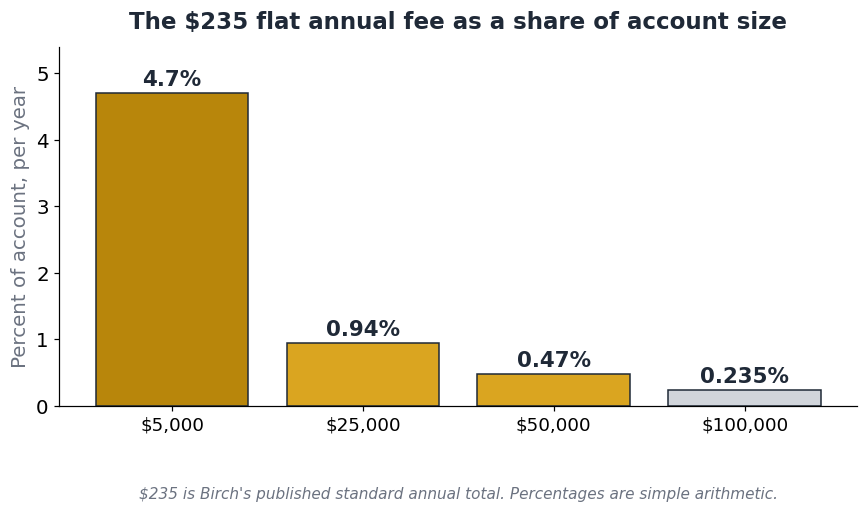
Second, the $235 is flat. Birch is explicit: “you will NOT be charged annually as a percentage of assets.” A $5,000 account and a $500,000 account pay the same $235 a year to the custodian and depository, on the standard schedule. Good news for large accounts. Rough news for small ones. At $5,000, $235 a year is 4.7% of the account, every year, before any premium on the coins. At $50,000, it is 0.47%. Flat fees punish small accounts. Birch does not hide the math. You should still do it before you open an account.
Third, Birch publishes no segregated-versus-pooled storage split. The $110 covers storage and insurance, full stop. Its fee guide discusses storage types in general — pooled storage is cheaper than keeping your exact coins apart — but gives no Birch price for either option. If keeping your own specific coins separate matters to you, ask what it costs, in writing, before you choose a depository.
The real cost: premiums and spreads
Birch does not quote product prices online. It says so directly, and gives its reasons, on its prices page: prices move minute to minute, an IRA transfer can take weeks, and a price quoted today would be stale by the time you buy. Instead, Birch says its specialists solicit bids from a network of wholesalers when you are ready to buy, and you get “a clear, detailed quote outlining all prices before confirming your order,” with prices locked once you confirm.
That is a reasonable explanation, and it is also a limit. You cannot comparison-shop Birch from your couch. You cannot check whether the coin a specialist recommends costs 5% over spot or 40% over spot until you are already in a conversation. Birch’s own fee guide is honest about the dealer side of this: “Like any precious metals dealer, we charge a premium over the spot price of precious metals like gold, similar to any retail business.”
So the rule for Birch is the same rule we give for every dealer in this series. Get the quote in writing. Make sure it shows, coin by coin, the metal value and the premium. Compare the per-ounce cost with spot and with one other dealer before you confirm anything. A written quote is not a courtesy. With Birch, it is the only price list you will ever see.
Minimums and who gets turned away
Birch’s IRA page puts it this way: “We recommend you start with a minimum of $5,000 in a retirement account.” Its fee guide is blunter: “the minimum for opening a precious metals IRA is $5,000.” The number itself never moves: $5,000.
That is the lowest IRA minimum in this series so far. Augusta asks $50,000. Goldco asks $25,000. Birch asks $5,000. For a saver rolling over a small old 401(k), that difference decides whether the conversation happens at all.
But read the last section again before you celebrate. At $5,000, the $235 annual fee alone eats 4.7% a year. Add a premium on the coins, and the first year can start deep in the hole. The low minimum gets you in the door. It does not make a small account cheap to run. If you have less than $5,000, Birch’s site gives you no published path in. And for a cash purchase outside an IRA, no minimum is published at all.
Products
Birch sells all four IRA-eligible metals: gold, silver, platinum, and palladium. Its IRA page lists coins, bars, and rounds, and its kit page names American Gold Eagles, American Silver Eagles, American Buffalo gold coins, and Silver Twin Maples among its IRA-eligible coins. IRA accounts can be Traditional, Roth, SEP, or SIMPLE, and Birch’s pages list the IRS purity rules for each metal.
What Birch does not do on its public pages is show you a catalog with prices. Its product range “rotates over time,” in its own FAQ wording, and your specialist walks you through what is available. If platinum or palladium is your reason for choosing a dealer, ask to see actual products and a written quote first.
For direct purchase, Birch offers home delivery with insured shipping and no additional fees, in its own words. That is a genuine difference from the IRA path: no custodian, no depository, no $235 a year. You still face the same premium question, and the same phone-only pricing.
Storage and custodians
This is one of Birch’s strongest sections, because it names names. Custodians: Equity Trust Company and GoldStar Trust Company. Depositories: Delaware Depository, Brink’s Global Services, International Depository Services, and Texas Precious Metals Depository. Birch’s prices page uses Equity Trust with Delaware Depository as its worked example. You choose your custodian and depository, and your specialist can recommend, but Birch says the choice is yours.
Your metals stay in your name at the depository, Birch says, and the depository is a separate institution from the custodian — a separation Birch presents as reducing the risk that one company controls both your paperwork and your metal. Storage is insured, the facilities are IRS-approved, and home storage of IRA metal is not allowed. Birch’s FAQ says that plainly, and it is right: IRA metal must sit in an approved depository until you take a distribution.
Buyback
Here is everything Birch publishes about buying your metal back, word for word, from its free-kit page, checked October 30, 2026:
“If you decide to sell your precious metals, we appreciate the first right of refusal to purchase them back, and offer fair and transparent pricing.”
That is the whole policy as published. No formula. No spread. No timeframe. No fee, stated either way. Birch’s fee guide adds one more sentence about buybacks in general: “unlike many precious metals dealers, we do not make any money when we buy back.” Taken together, the published position is: Birch wants the first chance to buy your metal back, says its pricing is fair and transparent, and says it makes no money on the buyback. How that works in practice — what price, how fast, what you receive versus what you paid, including the premium — is not published anywhere we could find.
“First right of refusal” is also worth reading carefully. It means Birch asks to be offered the metal first. It is not a promise to buy, and it is not a price guarantee. Before you buy, ask Birch to put the buyback terms in writing: price basis, speed, and any charge. Then keep that paper. The buyback is where the premium question comes home, as the complaint section below shows.
Promotions, decoded
Birch runs one promotion that matters, and it is printed on the same pages as the fees: on transfers over $50,000, Birch pays your first year’s fees. The IRA page says “Birch Gold will pay your first year’s fees.” The prices page says “your first year’s fees are waived entirely.” The fee guide says “Birch Gold Group will pay your first year’s Gold IRA fees.” Three wordings, same outcome: year one costs $0 in custodian and depository fees if you move more than $50,000. From year two, the $235 a year applies.
That is a real saving — $315 in the first year, counting the one-time fees — and it is also a threshold offer. It rewards larger transfers and does nothing for a $5,000 account. There is no free-silver offer on the pages we checked, and no other fee waiver with published terms. The free information kit is free, as advertised, and carries no purchase obligation that we could see.
Judge the waiver the same way you judge any dealer offer: by the total cost. A free first year does not help if the coins carry premiums that dwarf $315. Get the quote, with the premium shown, before you let a waived fee decide anything.
Reputation and complaints
We checked the Better Business Bureau ourselves on October 30, 2026, rather than trusting a badge on Birch’s homepage — the same check we run for every company in this series. What we found: an A+ rating, and BBB accreditation. Then the complaint counts, from the BBB’s own complaints page: 9 complaints in the last three years, 3 in the last twelve months. For a company Birch says has served more than 40,000 customers, that is a small complaint file. It is also not empty, and the complaints that are there share a theme.
Trustpilot tells a similar story from the other direction. On Trustpilot’s own page, checked October 30, 2026 (page last crawled October 29), Birch holds 4.8 out of 5 across 341 reviews. Trustpilot’s own summary of recent reviews praises knowledgeable, unhurried staff — and flags the same concern the BBB complaints raise: high premiums on certain coin purchases, and selling back at wholesale rates for lower returns. Birch’s own Trustpilot profile text claims an AAA rating from the Business Consumer Alliance. We did not independently verify the BCA score, so we report it as Birch’s claim, not as our finding.
Now the complaints themselves. Read the BBB complaint text, and one pattern dominates. Customers say they were steered toward specialty coins — Australian Florins feature in the most detailed complaint — told the coins would hold their premium value, and then found that the buyback offer came in at or near the metal value, with the premium gone. One complainant says the account was worth far less than the amount invested even after large rises in gold and silver prices, because so much of the money went to premiums. These are customers’ claims, published on the BBB site, and we report them as claims, not as proven facts. The dollar figures and percentages in those complaints are partly redacted on the BBB site, so we are not repeating them as verified numbers here.
Birch answered these complaints, in detail, on the BBB site. Its answers dispute the figures, say the premiums charged were lower than claimed and consistent with company policy, say pricing was disclosed in a signed transaction agreement and confirmed on a recorded line before purchase, and say the customers were coached by a competing dealer. Birch also says the customers in question did not lose money overall, once market gains are counted. We cannot settle that dispute from the outside. Both sides are on the public record, and a reader deciding about Birch should read both before judging either.
We found no regulator enforcement action against Birch Gold Group in our checks. Birch itself publishes a page denying online claims about lawsuits against it, calling them fabricated. We are not repeating those third-party lawsuit claims here, because we could not verify them. What the record does show, clearly, is the premium dispute: it is the live argument about this company, and it is about the one number Birch does not publish.
Pros and cons
Nothing below is opinion dressed up as fact. Each line traces to something verified earlier in this review.
Pros
- It publishes the whole fee schedule. Setup, wire, storage, management, annual total, and the first-year waiver are all printed on Birch’s own pages. In this industry, that puts Birch in a small minority.
- The $235 annual fee is flat. It does not rise with your account balance. A large account pays the same annual custodian and depository fees as a small one, on the standard schedule.
- The $5,000 minimum is the lowest in this series so far. Augusta asks $50,000 and Goldco $25,000. Birch opens the door ten times lower than Augusta.
- It names its partners. Two custodians and four depositories are named on Birch’s own pages. You know who will hold your paperwork and who will hold your metal before you sign.
- Four metals, and a home-delivery option. Gold, silver, platinum, and palladium for IRAs, plus direct purchase with insured shipping and no additional fees, in Birch’s own words.
- The complaint file is small, and the ratings are high. BBB A+ with 9 complaints in three years and 3 in the last year, checked on bbb.org on October 30, 2026. Trustpilot 4.8 out of 5 across 341 reviews.
- The first-year waiver is real and clearly stated. Over $50,000, year one costs $0 in custodian and depository fees. No fine print hunt required to find the threshold.
Cons
- You cannot see a single coin price without calling. No price list anywhere. The premium — the biggest cost — is only revealed in a quote, during a sales conversation.
- The buyback policy is two sentences. “Fair and transparent pricing” with no formula, no timeframe, and no stated fee. The “we do not make any money when we buy back” claim has no published workings behind it.
- The published fees are not Birch’s fees. They are the custodian’s and depository’s, for the combination most customers use. Pick a different custodian or depository and your numbers may differ — and Birch’s own pages say so.
- No segregated-storage price is published. The $110 storage figure has no split. If you want your exact coins kept apart, the cost is a question, not a printed fact.
- The flat fee punishes small accounts. At $5,000, $235 a year is 4.7% before premiums. The low minimum invites small accounts in, and the flat fee makes them expensive to keep.
- The founding date does not agree with itself. Birch’s own site says since 2011. Third-party profiles say 2003. A company that cannot settle its own start date on its own site invites a question it has not answered.
- The complaints, though few, go straight to the money. Premiums on specialty coins, and buyback offers that do not reflect those premiums. Birch disputes the claims in detail. The dispute itself is the warning: get the premium in writing, coin by coin, before you buy.
Who it fits / who should look elsewhere
Birch probably fits if you have $5,000 to $50,000 to move, you like a guided process with one specialist, and you are willing to do the one piece of work Birch cannot do for you: get the quote in writing, check the premium on every coin, and compare it with another dealer before you confirm. If you do that work, Birch’s published fees, named partners, and small complaint file give you a solid base to judge from.
Birch probably does not fit if you want to shop online. There is no price list, no catalog with prices, and no way to compare Birch’s coins with another dealer’s without picking up the phone. It does not fit if you want a published buyback formula before you buy — Birch does not print one. And if you have $50,000 or more and want the most complete published buyback terms in this series, read our Augusta review first.
How it compares
Against Augusta Precious Metals, Birch wins on the door and Augusta wins on the paper. Birch starts at $5,000 against Augusta’s $50,000, and both publish a $235-a-year ongoing schedule. But Augusta prints its buyback terms, its 7-day money-back guarantee, and one fee schedule that is its own. Birch prints custodian fees, keeps its buyback to two sentences, and leaves its coin prices to a phone quote. If you have $50,000 and want everything nailed down before anyone calls you, Augusta is the stronger starting point. Read the full Augusta review: Augusta Precious Metals Review.
Against Goldco, Birch is the cleaner read. Goldco publishes fee figures that disagree across its own pages — about $200 a year here, about $225 there — and names neither its custodian nor its depository. Birch publishes one schedule, names two custodians and four depositories, and charges $235 a year flat. Goldco’s minimum is $25,000; Birch’s is $5,000. On transparency alone, Birch leads this pair by a clear margin. Read the full Goldco review: Goldco Review.
Against American Hartford Gold, the comparison is short, and that is the point. American Hartford Gold publishes no fee figures, no minimum, and no fee schedule anywhere on its own site — our fee study verified that in October 2026, and it is the subject of a coming review in this series. Birch publishes all of them. A reader choosing between a company that prints its schedule and a company that prints none of it is not making a close call. (Full American Hartford Gold review coming; fee data in our 10-company fee comparison.)
FAQ
What are Birch Gold Group’s fees?
$50 to set up, $30 for a wire transfer, $110 a year for storage and insurance, and $125 a year in management fees. That is $315 in the first year and $235 a year after that — unless your transfer is over $50,000, in which case Birch pays your first year’s fees. One caveat: these are the custodian’s and depository’s fees for the combination most Birch customers use, not Birch’s own charges, and your figures may differ if you choose different partners. Sources: birchgold.com/precious-metals-ira and birchgold.com/prices.
What is Birch Gold Group’s minimum investment?
$5,000 for a Precious Metals IRA, stated on Birch’s own pages three ways — recommended, minimum, and required — but always $5,000. No minimum is published for a direct cash purchase outside an IRA. Source: birchgold.com/precious-metals-ira.
Does Birch Gold Group buy back the metals it sells?
It says it wants the first chance to. The exact published words are that Birch appreciates “the first right of refusal to purchase them back, and offer fair and transparent pricing.” No formula, timeframe, or fee is published. Ask for the terms in writing before you buy. Source: birchgold.com/resources/investment-kit.
Where are my metals stored, and who is the custodian?
Birch names them. Custodians: Equity Trust Company and GoldStar Trust Company. Depositories: Delaware Depository, Brink’s Global Services, International Depository Services, and Texas Precious Metals Depository. You choose; your specialist can recommend. No segregated-storage price is published. Source: birchgold.com/resources/investment-kit.
Is Birch Gold Group legitimate?
It is a real company, based in Des Moines, Iowa, with a BBB A+ rating and accreditation, 9 BBB complaints in three years and 3 in the last twelve months (checked on bbb.org, October 30, 2026), and a 4.8-out-of-5 Trustpilot score across 341 reviews. We found no regulator enforcement action in our checks. It also faces a small but pointed set of complaints about premiums on specialty coins and buyback values, which Birch disputes in detail on the BBB site. Both halves are true. Get the premium in writing, coin by coin, before any money moves. Our guide to choosing a gold IRA company has the full list of questions to ask.
Bottom line
Let us land the plane. Birch Gold Group does the one thing most companies in this industry will not do: it prints its fee schedule, in full, on its own website, and the schedule it prints today is the same one our fee study recorded on October 19. The $235-a-year flat fee, the $5,000 minimum, the named custodians and depositories, the first-year waiver over $50,000 — all of it is checkable, and we checked it. Add a small BBB complaint file and a strong Trustpilot score, and Birch earns its place on a short list.
But a short list is where the work starts, not where it ends. Because the schedule Birch prints is the custodian’s schedule, not Birch’s. Because no coin price appears anywhere on its site, and the premium — the cost that decides whether you come out ahead — only appears in a quote, on a call, from a specialist whose job is to sell you the coin. Because the buyback policy is two sentences long, and the complaints Birch has drawn are about exactly that gap: premiums paid up front, and buyback offers that do not remember them. Birch answers those complaints forcefully, and says the pricing was signed and recorded. We cannot settle that argument for you. We can tell you how to avoid becoming part of it.
So here is our advice, and it is the same advice we give for every company in this series. If you go with Birch, go with paper. The fee schedule, dated. The coin quote, per coin, showing metal value and premium, in writing. The buyback terms, in writing. All three, before a dollar moves. If a specialist will not put those three things in writing, believe the refusal. It just told you everything the website would not. You can start at birchgold.com (plain link, not an affiliate link).
Reader-supported disclosure: Gold Harbor Retirement is reader-supported. We may earn commissions from some companies we review. This page contains no affiliate links — the link above is a plain link to Birch Gold Group’s official site. We will update this note if that changes.

[…] Noble Gold vs. Birch Gold Group: Birch publishes one complete, consistent schedule — $235 a year flat, $315 in the first year, $0 in the first year on transfers over $50,000 — and it names four depositories to Noble Gold’s one. Birch’s minimum is $5,000, a quarter of Noble Gold’s. What Noble Gold offers in return: segregated-only storage (Birch publishes no segregated split), a Texas depository option, and a stronger Trustpilot score (4.9 across 799 reviews versus Birch’s 4.8 across 341). Both companies hide coin prices behind a phone call. If fee clarity is your test, Birch wins it. Read the Birch review: Birch Gold Group Review. […]